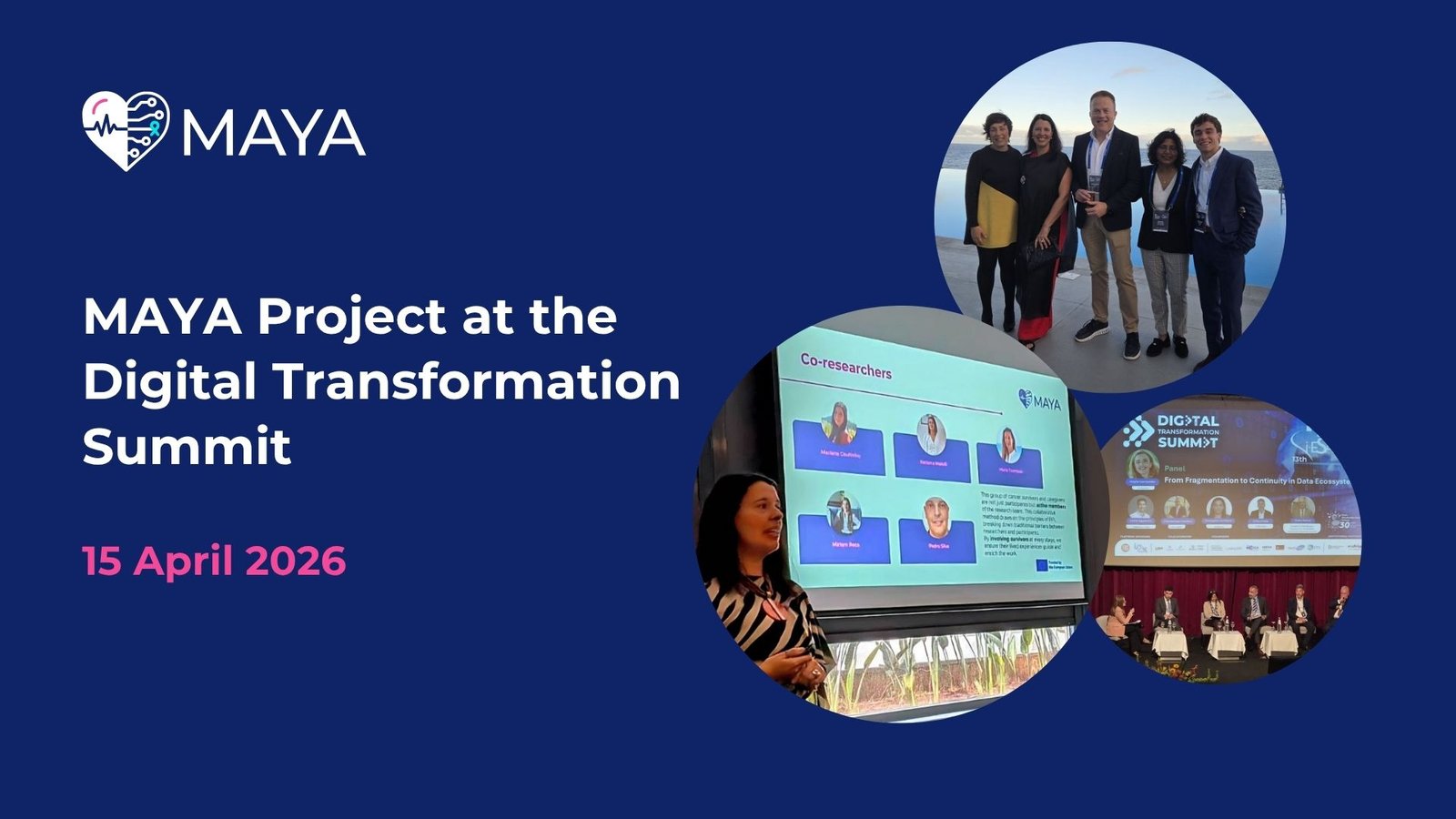
© Pictures by Carina Dantas
Maria Jose Santofimia and Carina Dantas from the MAYA Project were proud to organise the session “Cancer and Beyond: Practical Cross-Domain Digital Health Innovations” at the Digital Transformation Summit in Madeira, on 15 April 2026.
This session brought together experts from across Europe to explore how cross-domain collaboration is accelerating digital health innovation, from data infrastructures and explainable AI to sensing technologies, digital twins, and participatory innovation frameworks.
MAYA contributions were highlighted across multiple presentations, demonstrating how collaborative technologies and engagement models are shaping the future of cancer survivorship care and beyond.
Nirmalie Wiratunga (Robert Gordon University) presented advances in AI reasoning for clinical decision support, including technology applied within the MAYA project. Her work demonstrated how responsible, explainable AI and agent-based dialogue frameworks can integrate diverse health data to support cardiovascular risk management for young adult cancer survivors, helping move digital health solutions from research into practical clinical support.
Maria José Santofimia Romero (University of Castilla-La Mancha) introduced the Phyx.io digital ecosystem in the context of MAYA, showcasing how connected devices, conversational interfaces, and AI-driven analytics enable continuous home-based monitoring and personalised interventions. These solutions support young adult cancer survivors in actively managing their health, while enabling healthcare professionals to monitor risk factors and intervene at the right time.
The session concluded with Carina Dantas (SHINE 2Europe) presenting the importance of penta-helix collaboration, a key principle applied in MAYA. By bringing together patients, clinicians, researchers, industry, and policymakers, this approach ensures that digital health innovation is not only technologically advanced, but also inclusive, trusted, and responsive to real-world needs. Participatory approaches such as living labs, co-research, and patient and public involvement remain essential to scaling impactful digital health solutions across Europe.
A clear message emerged from the session: advancing digital health innovation requires both technological excellence and strong multi-stakeholder collaboration. By combining AI-driven tools, participatory methods, and cross-domain knowledge, initiatives like MAYA are helping to empower adolescent and young adult cancer survivors to better manage long-term cardiovascular health and wellbeing beyond cancer.
We thank the organisers of the Digital Transformation Summit Madeira for providing an inspiring platform to exchange knowledge, strengthen collaboration, and accelerate the adoption of digital health innovation across Europe.