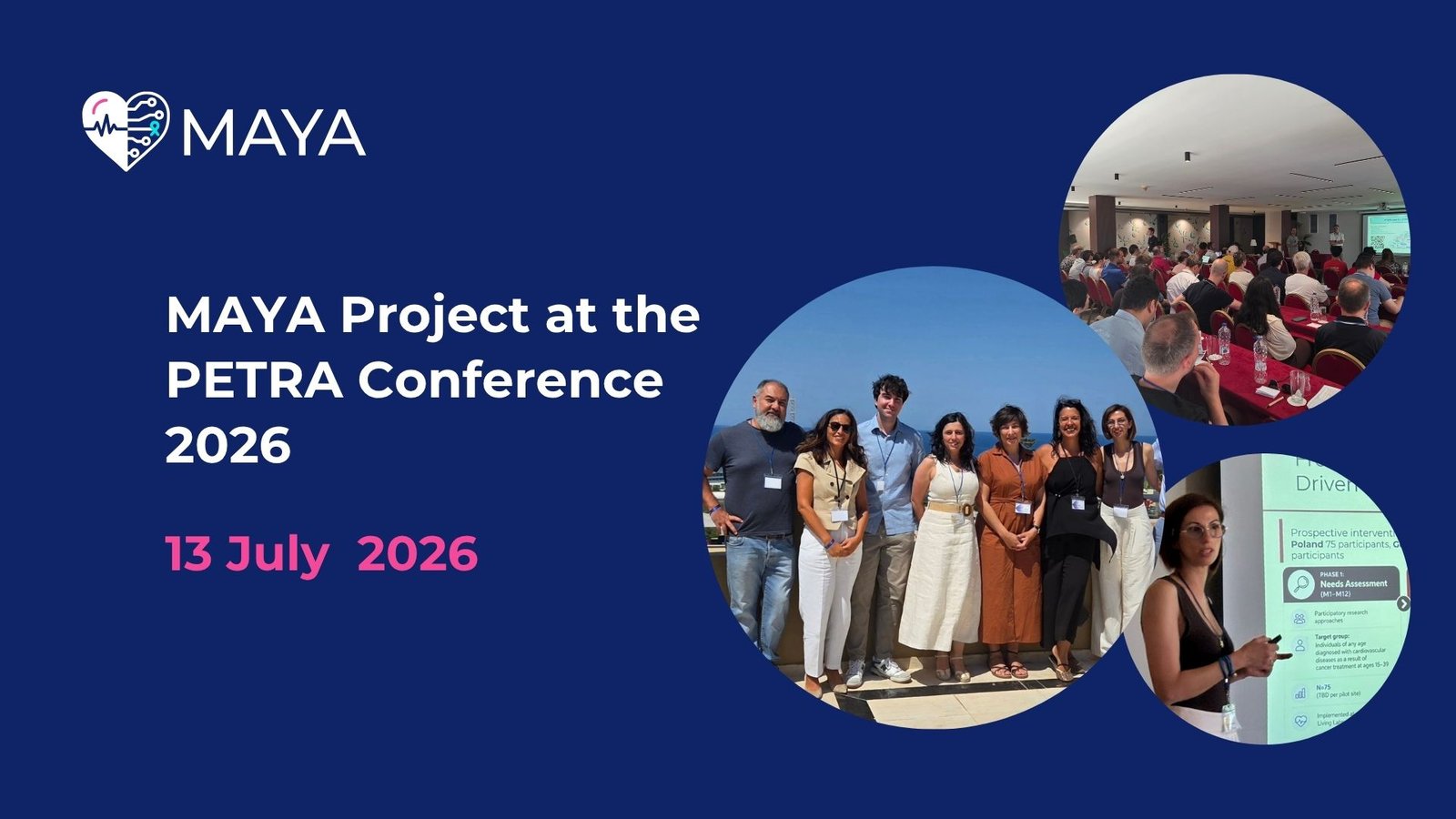
© Pictures by Carina Dantas
The MAYA Project was prominently featured at the 18th International Conference on PErvasive Technologies Related to Assistive Environments (PETRA 2026), held in Crete, Greece, through the dedicated workshop Advancing Smart Mirrors to Early Detect and Monitor Cancer Late-Effects through an Ethical and Participatory Approach (MAYA-Mirror).
The workshop, chaired by Carina Dantas (SHINE 2Europe) and María José Santofimia Romero (Universidad de Castilla-La Mancha), brought together researchers and innovators working at the intersection of artificial intelligence, smart environments, ethics and cancer survivorship. The session highlighted the growing potential of smart technologies to support the long-term health and well-being of Adolescents and Young Adults (AYA) cancer survivors, while reinforcing the importance of developing these solutions through meaningful stakeholder participation and responsible innovation.
As part of the programme, Carina Dantas presented the paper "Embedding Patient and Public Involvement in Digital Health Innovation: MAYA’s Co-Research Framework", demonstrating how the MAYA project has embedded Patient and Public Involvement (PPI) across all stages of the innovation process and Georgia Karanasiou (University of Ioannina) followed, introducing the vision behind MAYA's smart mirrors for supporting healthier lives after cancer.
Carlos Huesca-Spairani (University of Alicante) presented novel methods for level-based nudity estimation using skin segmentation and body-part mapping, addressing privacy-aware computer vision, while Maria Chatzimina (FORTH) showcased ALTHEA, an AI-supported platform for mental health monitoring in oncology care. Bogdan Vidrașcu (INOMED) shared early findings from the project's European Living Labs on the co-design of digital survivorship care and Marina Rosanu (European Institute of Oncology) explored the ethical and acceptability challenges surrounding wearable monitoring technologies for AYA cancer survivors.
Xavier del Toro Garcia (Universidad de Castilla-La Mancha) presented the development of the MAYA’s smart mirror-based physical exercise platform integrated within the iCARE Health Hub, while Elsa Pavlidou (FORTH) introduced the MAYA framework as a proof of concept for trustworthy smart health environments. The workshop concluded with Giuseppe Riccardo Leone (CNR), who presented innovative work on the application of Vision-Language Models for body morphology assessment.
The diversity of topics discussed throughout the workshop reflects MAYA's multidisciplinary approach, combining clinical expertise, artificial intelligence, ethics, participatory research, human-computer interaction and digital health to create next-generation survivorship solutions for young people living beyond cancer. By bringing together experts from multiple disciplines and institutions, this workshop reinforced MAYA's commitment to developing trustworthy, human-centred digital health technologies that are co-created with patients and designed for real-world implementation. The MAYA consortium thanks all presenters, participants and the PETRA 2026 organisers for an engaging and highly productive workshop that fostered dialogue, collaboration and new opportunities to advance ethical AI for cancer survivorship.